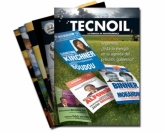
A new report on regional lithium is dealt with in this Cover Note. It includes players, prices, reserves, market evolution till present time and its future prospects.
As it has been doing in successive issues (307, 308, 310, 315 and 318), in this Cover Note Tecnoil is presenting a new report on current affairs regarding lithium, considered a strategic mineral for the economy of coming decades on account of its use in the manufacturing of batteries for electric cars.
The note unveils the outlook of the three countries making up the "lithium triangle," the largest accumulation of lithium from brine pools - the one having the least economic cost in the planet. Bolivia has defined development with strong State presence as the driving force of production, and goes ahead, in spite of difficulties, in the search of international agreements for future industrialization of the resource. In Chile, debate is starting regarding how a new scheme is going to be designed to develop lithium, when the game will be opened to new players, today restricted due to legal impediments. On the other hand, Argentina is on the news because of a boom in lithium exploration and production; in the Argentine case, both the absence of debate and a lack of strategy accompanying this flow of capitals with State policies are evident.
The second part of the note includes a detail analysis of the lithium industry at global level – based on work carried out by the Chilean Copper Commission (Cochilco, for its Spanish acronym): players, prices, reserves, market evolution till present time and its future prospects. In addition, it explains in detail the Chilean case; Chile is the largest lithium carbonate producer at present. “Because of the strategic nature of the mineral, the State currently plays and will play a significant role, let us say, essential for its development,” indicates Cochilco report.
Lithium appears as a potential development opportunity for a historically poor and marginal region. The Chilean document remarks on the convenience to work in developing a regional cluster around lithium: “This possibility increases greatly as long as the market is guaranteed in a large part of the lithium chain." In this regard, it is suggested to “explore the development of advanced industries for lithium carbonate uses in the region, for example, as it can be the manufacturing of metallic lithium or even the car batteries themselves.”
Argentina, Bolivia And Chile move their counters around the white gold
on the planet – includes the Argentine, Bolivian and Chilean salt pans. While Argentina is becoming “The Mecca” of the new investments in lithium, Bolivia is making progress on its lithium carbonate pilot plant and is studying proposals from several countries interested in reserves from Uyuni salt pan, although still not defining for any of them. On the other hand, in Chile the debate is starting on the exploitation model to be chosen by the Andean country to develop the resource in the coming years.
Argentina, the “Fashionable” Country for Lithium Investors
Such as Tecnoil has been pointing out (issues 310 and 318), in the last two years lithium exploratory projects have been multiplying, driven by foreign companies. In addition, there are two exploitation undertakings – one from the Australian Sentient Group in Rincón salt pan (Salta), and the other one from Orocobre, joining a project with its brand-new partner Toyota Tsusho in Olaroz Salt Pan, in the Province of Jujuy- which will increase the Argentine lithium supply in the short term, which today reaches 16,000 annual tones and belongs to FMC, in Hombre Muerto Salt Pan.
“Foreign companies are much more active than it was expected at the beginning. They want to invest in Argentina, and they want to do it just now", explained Facundo Huidobro, secretary to GEMERA, the chamber grouping the exploration companies operating in Argentina. On the other hand, Julio Ríos Gómez, the chairman of the entity, indicated that lithium “represents the great interest for the explorers” and it is “very significantly positioned” within the 20 projects involving mineral search projects which were started this year in Argentina.
Now, the Koreans
The Argentine Mining Secretariat has recently confirmed that Lithium One, a mining company based in Canada, will invest 15.1 million dollars in a lithium exploration program to be developed between the Departments of Los Andes (Salta ) and Antofagasta de la Sierra (Catamarca). The Government of South Korea will take part in the so-called “Salt of Life” Project, through Kores, its agency for mining development. The Korean state entity will financially support the works, in addition to include giants of the Korean industry such as GS Calex and LG International, through memorandums of understanding.
Bolivia Aims at being the "Owner" of Lithium from Uyuni
The Bolivian Government has fostered lithium development through state investment amounting to 8 million dollars in a lithium carbonate pilot plant –which would be around 70% to 80% of completion - while negotiating with companies from different countries how to develop the resource. The Bolivian model sets out the primary lithium export activity by the Bolivian State, and the entrance of private players mainly in the industrialization phases. “The important thing is that our Project is making process, we are not waiting for the actions of the companies without doing anything on our part,” the director of the Unit of Evaporitic Resources, Alberto Echazú explained recently. Among the private proposals, the ones to be remarked are that of French Consortium Bollaré-Eramet and that from Japanese firms Mitsubishi, Sumitomo and the state concern Japan Oil and Gas and Metals National Jogmec.
Several Proposals still Undefined
Evo Morales administration intends to agree upon the development of the value added to the resource on Bolivian soil, and also on the fact that the Bolivian state be the majority partner in these undertakings, “this issue is not so convincing for some interested people, as, for instance, the French case,” according to local mass media. The French have recently pointed out that: “If it is a battery plant, Bollaré has already done it in other countries." There is also evident interest on the part of Brazil, Korea, Iran, China and recently Finland; with the latter country there could be agreements for installation of an electro-chemical laboratory and batteries, design engineering programs, and supply of equipment for the industrial plant.
Chile, the Upcoming Debate
The currently effective Chilean Mining Code considers lithium a mineral that cannot be licensed. The two companies exploiting lithium in Atacama Salt Pan, SQM and SCL Chemetall have acquired the exploitation rights for the mineral; they previously held exploitation permits because both firms had their mineral rights registered before Law No. 18097 and the Mining Code ratified that lithium could not be licensed (see page 38).
Foreign interest in Argentine and Bolivian lithium raised the alert in some sectors in Chile, which point out that if no amendments are introduced to legislation and regulations governing the sector, Chile will in a short time lose leadership in the lithium business. Chile is at present the largest lithium producer. The claim includes modifications to the legal framework unblocking current restrictions and allowing for the opening of the business to a larger number of players.
Other sectors, represented in Parliament by Socialists Ricardo Núñez or Isabel Allende advocate for a model having State control and a greater State intervention in resource development -similar to the Bolivian model. For many people, the strategic condition of lithium even deserves the revision of current licenses. The incumbent Minister of Mining, Laurence Golborne, has recently remarked on the need for a debate on lithium allowing for “generating the adequate political consensus.” And he added: “It is important for resources held in the country to be exploited in the short term, so that we are not sitting on the reserves for the coming centuries.”
In the United States there is already Talk of Recycling Technologies
With the aim of “calming down” those who are worried about the concentration of lithium resources in a handful of countries, in the United States there is already talk of lithium recycling technologies. In 2009, the US firm Toxco received a subsidy amounting to 9.5 million dollars from the USA Department of Energy to develop activities tending to lithium recycling. Although at present it is much more expensive to recycle lithium than to extract it, according to a report by Argonne National Laboratory in Chicago, “virgin lithium will not be predominant in the market in 2040, because at that time recycling will be cheaper.” According to this assumption, those companies having the best recycling technologies will be predominant in the future lithium industry.
Lithium: Mineral of the future
Economist Camilo Lagos Miranda, from the Chilean Commission of Copper (Cochilco) dependent on the Department of Studies and Public Policies, has drafted a thorough report on current affairs in the lithium industry and its future perspectives in Chile and in the region. On these pages, Tecnoil presents data and main concepts of the document showing the outlook of an industry that will play a central role in energy matters in the next few years.
Demand for lithium carbonate equivalent (LCE) has duplicated in the last decade, reaching 90,000 annual tons at present. Additionally, this increase has been accompanied by a change in the breakdown of lithium uses in the last ten years. In 1998, lithium demand for batteries was only 7%; glass and ceramics constituted the largest destination for the mineral, amounting to 47%; greases and lubricants, 17%; aluminum, 6%; and air conditioning, 5%.
Demand for batteries currently represents the main application, amounting to 27%; greases and lubricants, 12%; glass mixtures –the input for some industries of the metalmechanic sector – 9%; glass and ceramics, 8%; air conditioning, 5%; aluminum, 4%; polymers, 4%; pharmaceutical uses, 3%; continuous casting, 3%. In addition to batteries, other lithium applications – such as air conditioning, lubricating greases, glasses, ceramics and pharmaceutical products – have also had a significant influence in consumption increase as it has been taking place in the last 10 years. Demand for lithium, excluding use of electric batteries, has grown around 5% per year.
The Electric Car to Boost Demand
The future development of electric and hybrid cars has aroused interest in this mineral from international markets, and thus raises lithium consumption forecasts in the future. There is consensus about lithium batteries being the best option to store power in electric vehicles (EV) and in hybrid electric vehicles (HEV). Between 2009 and 2012, approximately 10 car manufacturers are estimated to introduce EV and HEV models using lithium batteries. In 2007, approximately 500,000 hybrid vehicles (HEV) were sold, and Toyota is the main manufacturer of these models. In 2012, more than 2 million vehicles of this type will be available.
Supply and Demand for the Next Decade
World lithium demand is estimated to reach 158,000 tons of lithium carbonate by 2018. Expert Keith Evans issues a moderate estimate of current production capacity, around 104,000 tons of lithium carbonate equivalent. This would imply a deficit amounting to 54,000 tons by 2018, which could be noticeably decreased if production targets are met in China, namely 60,000 tons for 2010 (see box on page 35). Deficit would then be 14,000 tons. Other estimates point out that demand will reach between 250,000 and 300,000 tons in 2020, which would mean an annual average increase between 9% and 11% (and would imply a different scenario regarding supply and prices).
On the other hand, in 2008 SQM forecast an annual growth of 5% in lithium demand for next decade; rechargeable batteries would be the core demand, with growth rates reaching 10% per year. Towards 2018, rechargeable batteries will represent 42% of demand, and those intended for vehicles, around 10 and 15%.
Brines, the Main Source of Lithium Carbonate
Although lithium presence in Nature is vast, there are only two extraction processes feasible from the economic point of view: through brines and some minerals (spodumene, lepidolite, petalite, amblygonite and eucryptite).
Before SQM entered the market in 1997, most production of lithium carbonate came from minerals, particularly from spodumene. The best conditions regarding production costs finally led to production turning mainly to brines. If in 1995, sources for production of chemicals from lithium were 65% minerals, and the remaining 35% from brines; production from brines reached 86% by 2007.
Price Trend
Between 1990 and 1996, lithium carbonate was produced from mineral and brine deposits essentially due to Chemetall operations in SCL (Salar de Atacama) and Silver Peak. The market price was around 3,000 dollars per ton.
When SQM entered the market in 1997, producing 9,000 tons of lithium carbonate, prices fell by approximately 40% and stayed below 1,800 USD/ton. Between 1999 and 2004, the average prices remained stable between 2,000 and 2,500 USD/ton. Meanwhile, SQM production increased to 24,000 tons of LCE in 2003.
From 2005 on, the average prices of lithium carbonate increased sharply (by 90%), due to shortage in the market arising from several factors: among them, a strong increase in demand coming from battery applications, production problems in Salar de Atacama and the start up of lithium hydroxide by SQM, plus the impact inherent in the world economic cycle which increased the price of all minerals.
From 2006 onwards, lithium carbonate prices have tended to stabilize around 6,000 USD per ton. The economic crisis does not appear to have mostly affected the reference prices for lithium carbonate.
Are reserves enough, or not?
Keith Evans and William Tahil are two theoreticians who represent opposite positions in the debate that has been taking place in recent years, around availability of this compound to meet increases in demand as expected in the future. Total estimated resources vary from 21.8 million tons of lithium (Tahil, 2008), to 31.5 million (Evans, 2009). These differences go larger on Tahil's considering that only 6.8 million can be considered as economically feasible reserves, out of his estimate amounting to 21.8 million tons. In 2007, the same author remarked that only lithium coming from salt pans could be used to manufacture batteries, and deposits of spodumene would not be used for this, because only the first are “economically and energetically feasible for batteries.” If we consider that Tahil's estimates for lithium brine reserves were only 4 million tons, the expert also forecast severe problems for the industry of lithium batteries to have access to safe, reliable lithium sources in the long term.
On the other hand, Keith Evans has warned that the term ‘reserves’ as traditionally used by the USGS makes reference to those resources that can be extracted with existing technology at a specific price, which is usually the market price. The problem with this definition, according to Evans, is that prices change and technologies develop.
A Market Concentrated in a Few Hands
Lithium production is mainly concentrated in four countries. Chile leads the market with a 44% share (through brines); Australia, with 25% (through spodumene); China and Argentina produce through brines and reach 13% and 12% respectively. Likewise, only three firms virtually concentrate 77% of world lithium production, namely: SQM, with 30% of world market share, produces in Salar de Atacama; Chemetall, with 28%, has production plants in Atacama and in Nevada (United States); and the third firm is FMC Corporation, representing 19% of market share with operations in Salar del Hombre Muerto (Argentina).
Chile, World Leader in Lithium Production
Two companies produce lithium in Chile: SQM (former Soquimich) and SCL (Chemetall). Solely SQM represents approximately 37% of lithium carbonate world market, and between them they add up to 58% of global production. SQM is producing at its maximum plant capacity (recently opened) at a pace of 40,000 tons of LCE. Chilean exports of lithium products –carbonate, chloride, hydroxide – from SQM and SCL amounted to 263 million dollars in 2008, representing an increase of 20% as regards 2007 and 87% as regards 2006.
Royalties and Other Taxes in Chile
Producing companies operating in Salar de Atacama (SQM and SCL) are paying specific taxes (royalty), collected quarterly and representing 6.8% of lithium exports (carbonate, hydroxide or minerals). In addition, SQM pays 15,000 dollars annually as lease of its mineral rights. Exploitation in Atacama in turn establishes payment of royalty for extraction of other minerals, such as potassium, boric acid, magnesium, among others, which go from 1.8% - for potassium, boron and sulfate - to 10% for magnesium (sold jointly by SQM and SCL).
Salar de Atacama
In absolute terms, Salar de Atacama is the second in size among lithium deposits (the only deposit surpassing it is Salar de Uyuni), although it features a noticeable economic advantage in recovery of lithium contents. Concentrations in Salar de Atacama are the highest among known salt pans – 1,500 parts per million (ppm) in average, and variations go from 600 to 5,000 ppm. Due to these characteristics, this salt pan constitutes the best quality lithium reserve on the earth (see box page 36). On the other hand, climate characteristics in the Atacama desert enable the salt pan to offer, in turn, the highest evaporation rates in the world, reaching 3,700 mm/yr, a fact which noticeably contributes to decrease processing costs.
A Strategic Mineral
Lithium, according to effective Chilean legislation, is considered a strategic mineral, and the entire exploitation is under state supervision. This role of the Chilean state regarding lithium mining processes is related to the historical State interest in radioactive materials in the country. Lithium is not susceptible to mining licenses, according to the current Mining Code of the Transandean country (1979). At present, only Corporación de Fomento de la Producción; Corporation to Foster Production (CORFO), an agency within the Chilean State in charge of fostering national productive activity – holds mining rights in Salar de Atacama, where the lithium license was obtained before the 1979 Mining Code came into force. CORFO has leased part of these mining rights to SCL and SQM, under contract, not being allowed to exploit the rest of the mining rights for itself. Current license terms expire in year 2030.
Antofagasta, a Key Region
Lithium development in the so- called lithium triangle – made up of Chilean, Argentine and Bolivian salt pans – place the so-called Second Region in a privileged position, and particularly the City of Antofagasta, due to the concentration of the three most important salt pans as regards current lithium reserves, namely Atacama (Chile); Uyuni (Bolivia) and Hombre Muerto (Argentina).
At present, a significant portion of lithium carbonate exports coming from Salar del Hombre Muerto is sent to the United States via Antofagasta Port, taking advantage of Salta – Antofagasta railway. Likewise, future exploitation projects in Rincón and Olaroz en Argentina also consider Antofagasta as the exit door for their exports. On the other hand, although lithium production in Salar de Uyuni is still in its preliminary stages, its being close to the region (it is only 30 km from the Chilean Border), make Antofagasta Port stand out as the privileged place for exports coming from Bolivia.
Challenges and Recommendations
The document presents a number of challenges and future recommendations of public policy. Among them we highlight:
- Define the Role of the State: “Development of mining and the lithium industry in the future will to a great extent depend on the role that the State decides to play, whether through policies to attract capitals or changes to current legislation, or by playing an even more active role in the industry itself,” the document points out.
- Conduct an updated survey of reserves “independent, true, of the country’s reserves.” At present, there is no systematized knowledge of current lithium reserves in Chilean territory. Sernageomin has pointed out that the last survey of resources held in salt pans dates back to the late sixties, and at present the companies having authorization to exploit the salt pan are not obliged to deliver information on current reserves.
- Increase revenues by royalties: “Even maintaining the current status in lithium production matters, the possible increase of prices in the short term should be transferred to the Chilean State through larger amounts of collected taxes.”
A Cluster around Lithium?
The document states the convenience involved in making up a cluster around lithium: “This strategic condition of the region concentrating the largest current lithium reserves should be seriously considered in the perspective to develop a lithium cluster in the region, whether national or international, as well as from the perspective of economic integration between these three countries.” The document adds the need to “explore the development of advanced industries in the region for lithium carbonate uses, for example, as it can be the manufacturing of metallic lithium or even the electric car batteries themselves.”